Link Building Automation: Tools, Workflows, and ROI for SEO Automation
Link Building Automation: Tools, Workflows, and ROI for SEO Automation
What Is Link Building Automation and When to Use It
Link building has always been labor-intensive. Identifying prospects, verifying contact details, crafting outreach, following up, and tracking placements can consume dozens of hours per campaign. Automation doesn't eliminate that work — it compresses the repeatable parts so your team can focus on what actually requires judgment.
Within a broader SEO automation strategy, automated link building sits alongside technical auditing, rank tracking, and content optimization. The distinction is that link building involves external parties, which means automation decisions carry reputational risk alongside efficiency gains.
How Automation Fits Into SEO Automation
Automation excels at three stages: prospecting at scale, sequencing follow-up outreach, and consolidating reporting. Finding 500 relevant domains, validating their metrics, and scheduling a three-touch email sequence is genuinely faster and more consistent when software handles it. Humans, on the other hand, should own strategy (which link types to pursue, which anchors to build), personalization beyond mail-merge tokens, and any relationship that might yield multiple placements over time.
Manual vs. Automated Trade-Offs
The trade-off isn't binary. A skilled outreach specialist sending 30 highly personalized emails will often outperform a fully automated blast of 300 generic messages — both in reply rate and in the quality of sites that respond. The goal is a hybrid: automation handles volume and consistency; humans handle nuance.
Use Cases by Company Size
A bootstrapped SaaS founder might use a single auto backlink tool to find guest post targets and schedule two follow-ups. An enterprise SEO team might run a full seo automated link building stack with dedicated ops, CRM integration, and weekly placement reporting to the C-suite. Matching automation depth to your link velocity goals — rather than adopting every feature available — keeps complexity manageable.
Core Features to Evaluate in Link Building Automation Tools
Not all link building automation tools are built the same. Before committing to any platform, evaluate it across three functional areas.
Prospecting and Qualification
Scalable prospecting is table stakes. Look for automated backlink building tools that pull from regularly refreshed databases, apply relevance scoring based on topical proximity, and deduplicate prospects against your existing link profile and outreach history. A tool that surfaces 10,000 domains means nothing if 6,000 are irrelevant or already acquired.
Domain authority thresholds, organic traffic minimums, and outbound link ratios should all be configurable filters — not manual checks you run separately.
Outreach and Personalization
Auto link building software should support dynamic templates that go beyond {{first_name}} substitution. Look for conditional blocks (different copy for SaaS vs. media sites), inbox rotation across multiple sending addresses, and sending-rate scheduling that respects per-domain daily limits. These features protect deliverability and keep campaigns out of spam folders.
Tracking, Analytics, and Integrations
Once a link is placed, you need to know if it stays placed. Require automatic backlink software that monitors live links and fires alerts when a page is deleted, a link is removed, or a site goes offline. On the analytics side, native integrations with your CRM, Google Search Console, and rank tracking platform unify data that would otherwise live in four separate spreadsheets.
Top Automated Link Building Tools and Software Landscape
The market segments into three broad categories: outreach CRMs (Pitchbox, BuzzStream, Respona), prospecting databases (Ahrefs, Semrush, Majestic), and backlink monitoring platforms (Monitor Backlinks, LinkChecker.pro). Effective seo automated link building usually means combining tools from at least two categories.
Backlink Automation Software Types
Outreach CRMs manage sequences and contact records. Prospecting databases surface link targets and supply authority metrics. Monitoring tools watch placements post-acquisition. There's no single platform that genuinely excels at all three, which is why most mature programs run a two- or three-tool stack.
Shortlist Criteria
The best automated link building software shares a few traits: high deliverability infrastructure, data that's refreshed at least monthly, transparent compliance documentation, and audit logs so you can review what was sent and when. Vendor response time and documentation quality are underrated — when a campaign breaks at 11 PM, you need answers.
Vendor Ecosystem and Add-Ons
Many auto backlink software platforms integrate with enrichment services (Hunter.io, Apollo) for contact-finding and verification services (NeverBounce, ZeroBounce) for email validation. These add-ons are often worth the incremental cost: a 15% reduction in bounce rate meaningfully extends the life of your sending domains.
One category to avoid entirely: any tool marketed as an automated backlink generator that promises hundreds of links with no outreach. Those auto seo backlinks overwhelmingly land on spammy directories and private blog networks — the kind of footprint that manual Google reviewers and algorithmic filters both penalize.
Pricing, ROI, and Total Cost of Ownership
Cost Drivers and Tiers
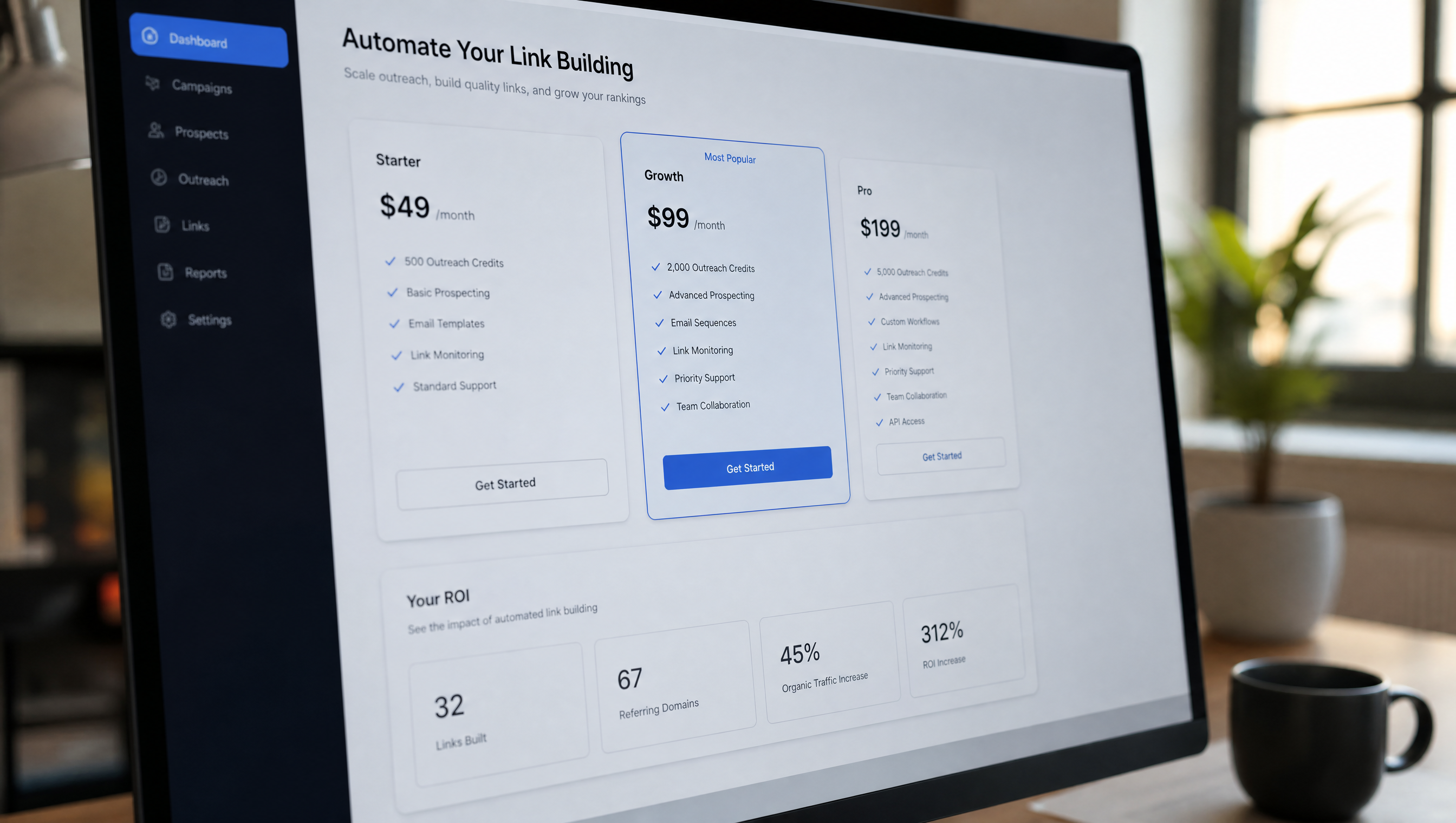
Pricing across auto backlink software typically scales along four axes: seats (users on the platform), email send volume per month, prospect credits (database lookups), and monitored links. Entry-level plans for a solo practitioner might run $99–$200/month. Enterprise tiers with unlimited seats, high send volume, and API access can reach $1,500–$3,000/month before add-ons.
ROI Model and Benchmarks
A practical ROI model looks like this: estimate the incremental organic traffic a new link will drive based on the ranking improvement it supports, apply your site's conversion rate, and multiply by customer LTV. If a single high-authority placement is worth $800 in pipeline and your cost per acquired link runs $120 (tool cost + labor), the math is straightforward.
Automated link building tools typically show payback within 60–90 days for companies already running outreach campaigns manually, because they reduce the per-link labor cost by 40–60%. Compared to agency retainers that often charge $200–$500 per placed link, a well-run in-house automation stack can deliver the same volume at roughly half the cost within six months.
Hidden Costs and Risk
Budget for inbox warm-up time (2–4 weeks before scaling send volume), data enrichment subscriptions, and campaign rework when a message sequence underperforms. Failed campaigns aren't free — they consume prospect credits, damage domain reputation, and require copywriting revisions.
Implementation Playbook: From Trial to Scaled Automation
30-60-90 Day Rollout
Days 1–30: select your stack, configure domain authentication (SPF, DKIM, DMARC), import your first prospect list, and run a limited test sequence of 20–30 contacts. Measure reply rate and placement rate before scaling. Days 31–60: iterate on messaging, expand sends to 100+ contacts per week, and establish your CRM integration. Days 61–90: formalize reporting dashboards, assign team roles, and set weekly send targets based on validated performance data.
Safety and Deliverability
Warm new sending domains for at least three weeks before campaign sends. Cap daily sends at 30–50 per inbox initially, rotating across multiple inboxes to distribute volume. Monitor spam complaint rates — anything above 0.1% warrants an immediate pause and template review.
Workflow and Team Roles
A functional automated link building team needs four roles: a strategist who sets target link types and anchor ratios, a copywriter who owns template creation and personalization logic, an ops lead who manages the toolstack and sequence scheduling, and a QA reviewer who verifies placements and flags removals. Define SLAs: responses handled within 24 hours, placement verification within 48 hours of confirmation.
Compliance, Quality Control, and Risk Mitigation
Google Guidelines and Policy Alignment
Google's link spam policies explicitly prohibit large-scale link exchanges and any scheme that manipulates PageRank. Automation doesn't create new violations, but it makes it easier to violate guidelines at scale. Every tactic in your automated link building workflow should pass a simple test: would you be comfortable if Google's webspam team reviewed this campaign?
Quality Thresholds and QA
Before outreach proceeds, filter prospects against minimum thresholds: DR 30+, 500+ monthly organic visitors, topical relevance score above your defined baseline, and an outbound link ratio below 50 links per page. Automatic backlink software should then monitor placements monthly and flag any site that drops below threshold post-acquisition.
Run quarterly audits of your acquired links. Remove or disavow links from sites that have decayed significantly, been sold to new owners, or shifted to irrelevant topics.
KPIs and Executive Reporting
Standardize on four KPIs: cost per acquired link, percentage of dofollow placements, authority distribution (what share of links come from DR 50+ domains), and revenue impact tied back to ranking improvements. Report these monthly to stakeholders. When the data shows cost per link creeping above your benchmark, it's a signal to audit your prospect quality filters — not to increase send volume.