SEO Automation for Audits, Analysis, and Research
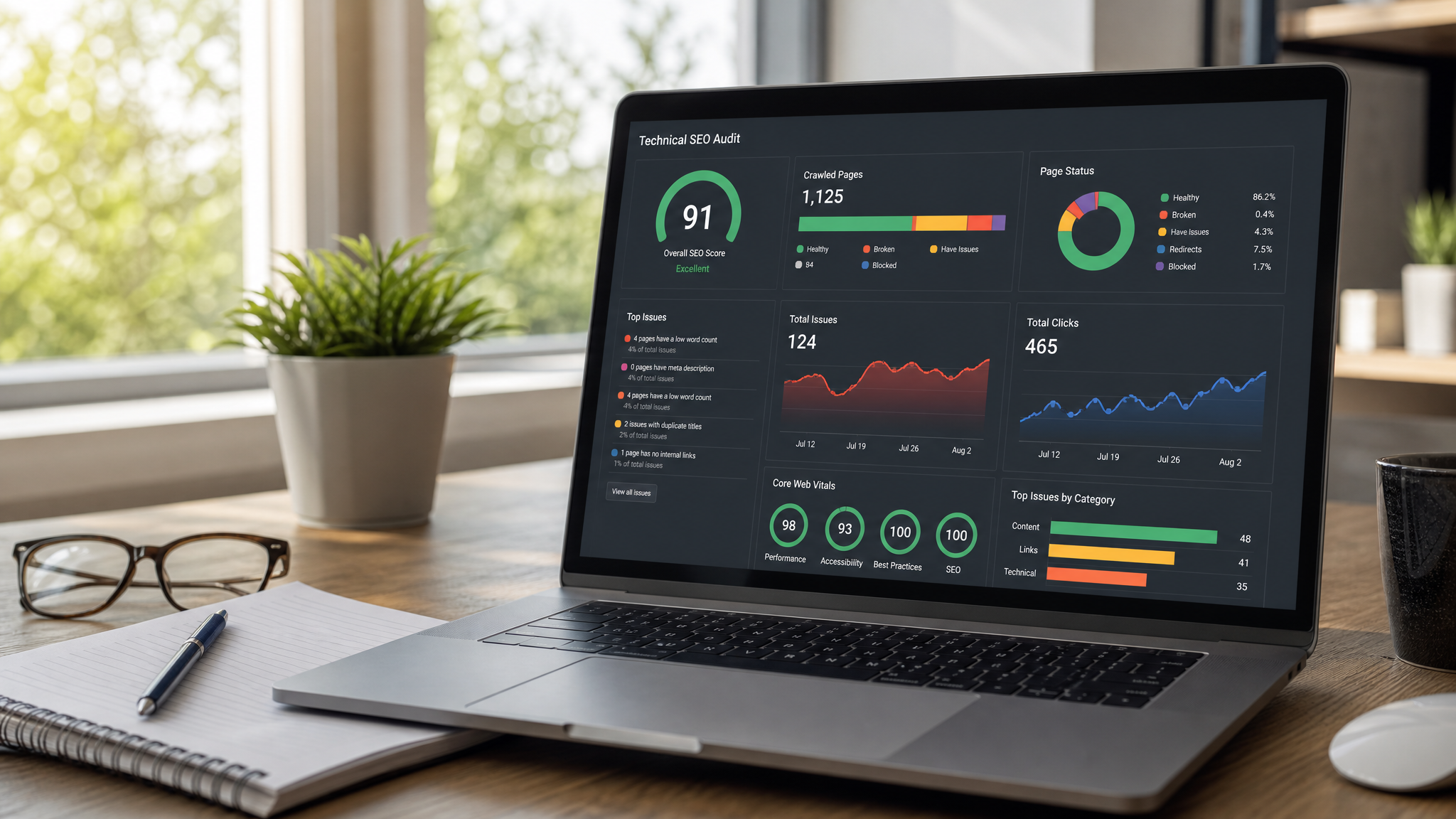
SEO Automation for Audits, Analysis, and Research
Manual SEO work doesn't scale. A site with 50,000 pages, a competitive keyword universe spanning thousands of terms, and stakeholders who need weekly reports cannot be served effectively by spreadsheets and one-off crawls. SEO automation changes that equation — and for teams serious about growth, it's no longer optional.
What Is SEO Automation and Why It Matters
SEO automation is the practice of replacing or augmenting manual, repetitive SEO tasks with scripted workflows, APIs, and scheduled processes. That covers everything from crawling pages for broken links to clustering thousands of keywords by intent to generating audit reports without human intervention.
Core Benefits
The most immediate gain is time. Tasks that take an analyst four hours — pulling rank data, cross-referencing against traffic, flagging anomalies — can run overnight and land in an inbox before the workday starts. Beyond speed, automation brings consistency. A rule applied by a script runs the same way every time; a manual checklist doesn't. That repeatability matters when you're managing audits across dozens of client sites or tracking hundreds of competitors.
Speed-to-insight is the third lever. When a site migration goes wrong at 2 a.m. and automated alerts fire within minutes, teams can respond before rankings crater. Waiting for a weekly manual review is simply too slow for modern campaign management.
Where Automation Fits in SEO Workflows
Automation isn't a replacement for strategy. It handles the mechanical layers — data collection, normalization, anomaly detection, and reporting — so analysts can focus on interpretation and decision-making. Think of it as infrastructure: it runs underneath the strategic work, making everything faster and more reliable.
Automating SEO Audits
A site audit is only as good as its freshness. A crawl you ran three months ago tells you nothing about the redirect chain introduced last Tuesday. Automation solves the staleness problem.
Crawl and Diagnostics
Crawler APIs from tools like Screaming Frog, Sitebulb, or custom Python-based spiders (using libraries such as Scrapy) can be scheduled to run on a defined cadence — daily for large e-commerce sites, weekly for content-heavy properties. Each run produces a structured dataset of URLs, status codes, redirect chains, canonical tags, and sitemap coverage. An automatic SEO audit that runs without anyone pressing a button means you're always working from current data.
Technical SEO Checks
Beyond basic crawl data, automated workflows should validate Core Web Vitals via the PageSpeed Insights API, check indexation status through the Google Search Console API, and confirm structured data validity using schema validation endpoints. Redirect audits — particularly detecting redirect chains longer than two hops or loops — can be scripted to run against every new deployment. The output isn't a raw list; it's a prioritized issue queue scored by estimated impact. A missing canonical on a high-traffic category page ranks higher than a broken image on an archived blog post.
Reporting Cadence
Automated reports should push to stakeholders on a schedule — weekly summaries, immediate alerts for critical issues. A dashboard showing new vs. resolved issues week-over-week gives leadership a clear signal of SEO health without anyone manually compiling data. Alerts triggered by threshold breaches (say, a 10% drop in indexed pages) go directly to Slack or email so nothing slips past.
Automated SEO Analysis Workflows
Audits tell you what's broken. Analysis tells you why performance is moving and what to do about it. Automated SEO analysis brings the same discipline to on-page factors, competitor tracking, and content gaps.
On-Page and Content Quality
At scale, manually reviewing title tags, meta descriptions, and H1s across thousands of pages is impractical. Automated pipelines can flag duplicates, overly long or truncated titles, missing meta descriptions, and header hierarchy violations in a single pass. The same logic applies to internal linking: scripts can map link depth from the homepage, surface orphan pages receiving no internal links, and identify crawl waste from paginated URLs that dilute crawl budget.
Competitor and SERP Intelligence
Rank tracking APIs deliver daily position data, but the real value comes from layering in SERP feature monitoring. An automated workflow that checks whether a competitor gained a featured snippet for a target keyword — and cross-references it against your current structured data implementation — gives you an actionable signal, not just a number. Scheduled competitor page monitoring (using change-detection scripts or third-party tools) can flag when a rival updates a key landing page, prompting a content review on your end.
Content Gap Discovery
Combining your current keyword rankings with a target competitor's keyword footprint, automated gap analysis surfaces terms where competitors rank but you don't. These feeds directly into the keyword research pipeline — closing the loop between analysis and content strategy.
Automated Keyword Research and Clustering
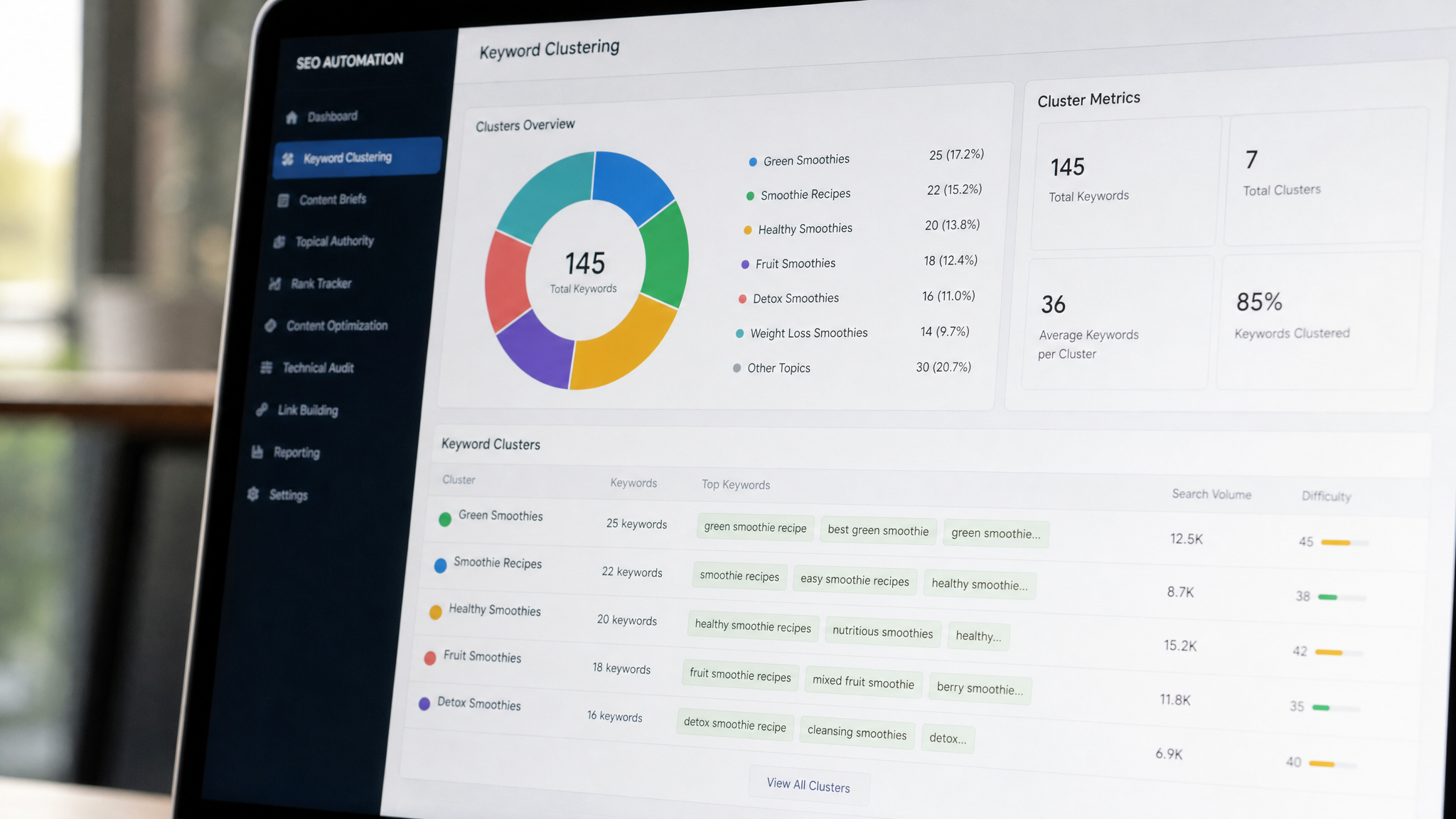
Keyword research is one of the most time-intensive tasks in SEO and one of the most automatable. A well-built pipeline replaces days of manual work with a process that runs on demand.
Seed Expansion and Modifiers
Start with a seed list — core topics relevant to the business — and push those through keyword expansion APIs (Google Ads Keyword Planner, Semrush, Ahrefs, or DataForSEO). Automated pipelines append modifiers systematically: question formats ("how to," "what is"), location qualifiers, comparison terms ("vs," "alternative"), and long-tail variations. A seed list of 50 terms can expand to 10,000+ candidates in a single run.
Intent Classification and Clustering
Raw keyword lists are noise. Automated keyword research becomes useful when terms are grouped by semantic similarity and search intent. Clustering algorithms — whether TF-IDF cosine similarity, embedding-based models, or SERP-overlap clustering — group related terms so that a single piece of content can target a meaningful cluster rather than a single keyword. Intent labels (informational, navigational, commercial, transactional) are appended using SERP result classification, giving content teams a clear brief before they write a word.
Prioritization Modeling
Each cluster gets scored across multiple dimensions: monthly search volume, keyword difficulty, estimated CTR based on SERP features present, and business value (derived from conversion data or revenue proxies). The output is a ranked backlog of content opportunities, ready to slot into an editorial calendar without further manual triage.
Tools, Data Sources, and Integration Stack
The technology layer behind SEO automation typically involves four categories working together.
Data and APIs form the ingestion layer — crawler APIs, rank tracking APIs, keyword data APIs, and Search Console/Analytics connections provide the raw inputs. Orchestration tools schedule and sequence the work: cron jobs for simple tasks, Apache Airflow or cloud-native schedulers (AWS Lambda, Google Cloud Functions) for complex multi-step pipelines. ETL processes normalize data from disparate sources into a central warehouse (BigQuery, Snowflake, or similar), ensuring consistent schema and historical continuity. BI dashboards — Looker Studio, Tableau, or Power BI — surface KPIs and audit outcomes to stakeholders, while Slack and email integrations handle threshold-based alerting in real time.
Implementation Plan, QA, and Best Practices
Quality Assurance and Governance
No automation should go straight to production across an entire site. Pilot on a representative subset — 1,000 to 5,000 pages covering different templates — and validate outputs against a manual benchmark. If the automated audit flags 120 title tag issues and manual review confirms 115 of them, that's a reliable signal. Version control every rule set, configuration file, and reporting template in Git so changes are traceable and rollbacks are clean.
Alerting and Change Management
Alert fatigue kills adoption. Tune thresholds carefully — a crawlability alert should fire when indexable pages drop by 5%, not every time a staging URL appears in the sitemap. Review alert history quarterly and suppress or raise thresholds based on signal-to-noise ratios observed in practice.
KPIs and Continuous Improvement
Measure what matters: organic traffic change, ranking movement on target clusters, and mean time to resolve audit-flagged issues. If automated processes are working, issue resolution time should drop and ranking velocity should improve. Revisit models and rules every quarter — SERPs evolve, algorithm updates shift what matters, and sites grow in ways that require pipeline adjustments.
Haze Tech Solutions builds these automation layers as integrated systems, not bolt-on tools. The goal is always the same: faster insight, fewer manual bottlenecks, and SEO results that compound over time.