AI SEO Tools for Meta and Title Generators: Buyer's Guide

AI SEO Tools for Meta and Title Generators: Buyer's Guide
What Are AI SEO Tools for Meta and Titles?
Search engines read your title tags and meta descriptions before almost anything else on a page. Get them wrong and you bleed clicks even when you rank. AI SEO tools solve this at scale by automating the drafting process through natural language processing and live SERP data—so your team stops writing metadata one page at a time.
How These Generators Work
A modern AI SEO title generator pulls your target keyword, analyzes top-ranking results for that query, and assembles phrasing that balances search intent with click appeal. The output respects character limits, avoids keyword stuffing, and mirrors the tone of pages Google already rewards. A meta description AI generator does the same for the snippet, drafting concise summaries that stay inside pixel-safe thresholds—roughly 920 pixels on desktop—while hitting your brand voice.
Where They Fit in Your Stack
These tools don't replace your CMS or crawlers. They plug into them. Most connect directly to platforms like WordPress, Shopify, or custom CMS builds via API, and many accept crawl exports from Screaming Frog or Semrush so you can target pages with missing or truncated metadata first. Output flows back into your publishing workflow rather than creating a separate silo.
Benefits and Limitations
The gains are real: faster publication cycles, more consistent brand language, and measurable CTR improvement when titles shift from generic to intent-matched. The ceiling is equally real. No AI SEO description generator catches every factual error or brand nuance. Human QA remains non-negotiable. Treat these tools as a first draft engine, not an autopilot.
Core Features to Evaluate Before You Buy
Not every meta description generator AI is built for the same workload. A blogger refreshing 50 posts needs different features than an ecommerce team managing 50,000 SKUs.
Quality and Compliance
Start with output controls. Can you set character or pixel limits? Can you lock in brand tone—whether that means authoritative, conversational, or technical? Look for a built-in SERP preview that renders both desktop and mobile results so you catch truncation before publishing. Duplication detection is also essential; search engines penalize sites where dozens of pages share identical metadata, and a good tool flags this automatically.
Workflow and Scale
Bulk generation separates serious platforms from novelty tools. If you're running a catalog of hundreds or thousands of pages, you need template libraries, batch processing, and version history so you can roll back a bad prompt. Check whether the platform supports A/B variant creation at the URL level—this matters when you want to test two title formulations and push the winner via API.
Data and Integrations
The best AI SEO tools pull in live keyword and SERP data rather than relying on stale training sets. CMS integrations should be bidirectional: push drafts out, pull current metadata in for auditing. Spreadsheet compatibility (Google Sheets or Excel exports) keeps large batch reviews manageable for teams that don't want to live inside a SaaS dashboard. Multilingual support and schema hints round out a mature feature set for enterprises operating across markets.
Top Commercial Use Cases and Workflows
Ecommerce and Marketplaces
An ecommerce team with 10,000 product pages can't write unique metadata by hand. An AI SEO title generator changes this math. Feed the tool a product name, category, key attribute, and target keyword, and it produces a title formatted for both ranking and click-through in seconds. Bulk runs that previously took weeks drop to hours. Pair this with a meta description AI generator to fill in the snippet—leading with a benefit, closing with a soft call to action—and you have complete metadata for entire catalogs in a single workflow.
Editorial and Blogs
Legacy blog archives are low-hanging fruit. Pages with strong organic rankings but poor click-through rates often suffer from outdated or vague metadata. Running a crawl export through an AI SEO description generator surfaces these gaps, and the tool drafts replacements tuned to current search intent. CTR lifts of 10–25% on refreshed posts are common when titles shift from descriptive to intent-specific. The key is auditing before generating—fix the worst performers first.
Local and Multi-Location
A franchise or multi-location business faces a localization problem at scale. Every city-specific service page needs unique metadata that incorporates location terms without sounding templated. AI tools handle this by injecting location variables into reusable prompt templates, preserving brand language and keyword targets while producing content that reads as locally relevant. Deploying these across hundreds of location pages via API takes the work from months to days.
Comparing Leading Meta and Title Generators
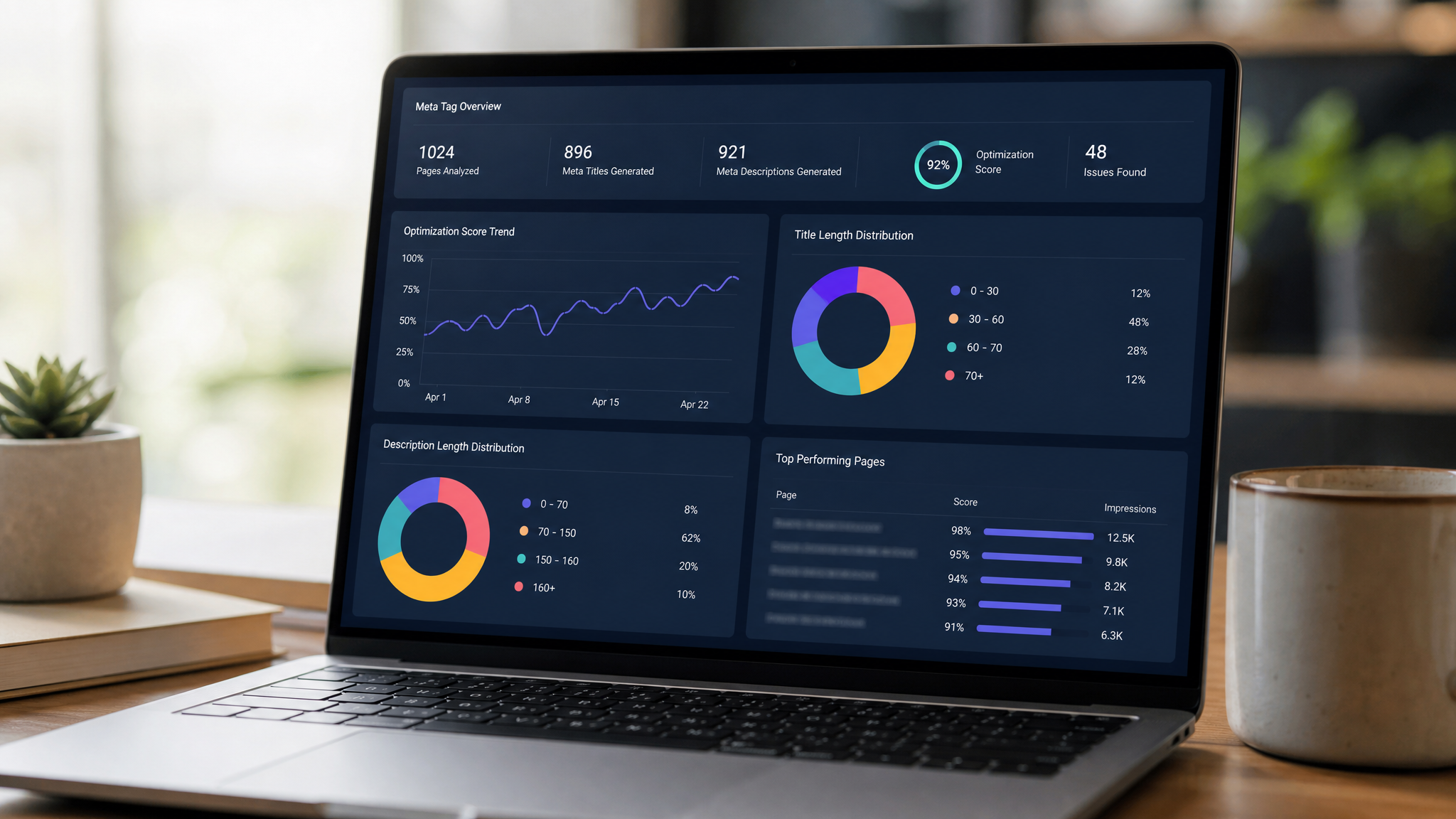
Differentiators That Matter
Training data quality drives output quality. Ask vendors whether their models were fine-tuned on SERP data or generic web text—the difference shows up in how well the tool understands search intent versus just keyword presence. On-page scoring accuracy, where the tool grades your metadata against competitors, separates the analytical platforms from basic text generators. Confirm that meta description AI generator outputs are deduplicated before delivery, not after.
Pricing Models
Pricing structures vary widely. Some tools charge per seat, others per credit or per word generated. For high-volume use cases, per-word pricing adds up fast—a catalog of 50,000 SKUs can exhaust a credit budget in one batch run. Estimate your monthly generation volume before committing. Many vendors offer tiered plans where API access only unlocks at higher tiers, so map your integration requirements against pricing early.
Security and Governance
Enterprise buyers should ask about SOC 2 Type II certification and data handling policies. Does the platform store your content? Can prompts containing proprietary product data be used to train shared models? For regulated industries, private model inference—running generation on your own infrastructure—may be a requirement. Approval workflows, role-based permissions, and change logs aren't glamorous features, but they determine whether you can deploy AI metadata at scale without governance headaches.
Implementation Strategy and Optimization Tips
Prompt and Template Design
The quality of your output is a direct function of your prompt design. Build reusable templates for each content tier—product pages, category pages, blog posts, location pages—with slots for primary keyword, secondary keyword, and brand suffix. Constrain title templates to keep the primary keyword within the first 60 characters. Locking these structures in from the start produces consistent output and makes QA faster.
QA and Measurement
Set pixel-safe limits in your templates and run SERP preview checks before any bulk publish. After deployment, track CTR, impressions, and average position in Google Search Console segmented by the pages you updated. This attribution matters—it tells you which content types responded best and informs your next batch. Spot-check at least 5–10% of generated metadata manually for every major run, and establish a policy guardrail document that defines what the tool is not allowed to write.
Scaling Safely
Roll out in stages. Start with 200–500 URLs, measure lift over four weeks, then expand. This pacing protects you from deploying a flawed prompt template across your entire site at once.
RFP Checklist and Next Steps
Questions for Vendors
Request a live demo that walks through the full AI SEO description generator and title workflow—not a slide deck. Ask specifically about customization depth, multilingual capability, and the integration path for your CMS. Push for references from clients with similar catalog sizes or content types.
Pilot Plan
A four-week pilot on 200–500 URLs with a holdout group gives you clean data. The holdout pages stay with original metadata; the test pages get AI-generated versions. The delta in CTR and revenue per session tells you what the tool is actually worth before you sign an annual contract.
Success Metrics
Define success before you start: statistically significant CTR improvement and measurable revenue-per-session gains on updated pages. Equally important, document your governance model—who writes the templates, who approves outputs, who monitors for quality drift, and who has authority to roll back changes. AI SEO tools deliver ROI when the technology and the process are both in place.