ChatGPT for SEO: How to Use AI SEO Tools to Win Organic Traffic
ChatGPT for SEO: How to Use AI SEO Tools to Win Organic Traffic
Organic search is competitive, and the gap between teams that move fast and teams that don't is widening. AI SEO tools — ChatGPT chief among them — have become a practical way to close that gap. Used well, they compress research and drafting cycles from days to hours. Used carelessly, they produce thin content that tanks rankings. This guide covers how to get the former and avoid the latter.
What Is ChatGPT for SEO and Why It Matters
Understanding AI SEO Tools
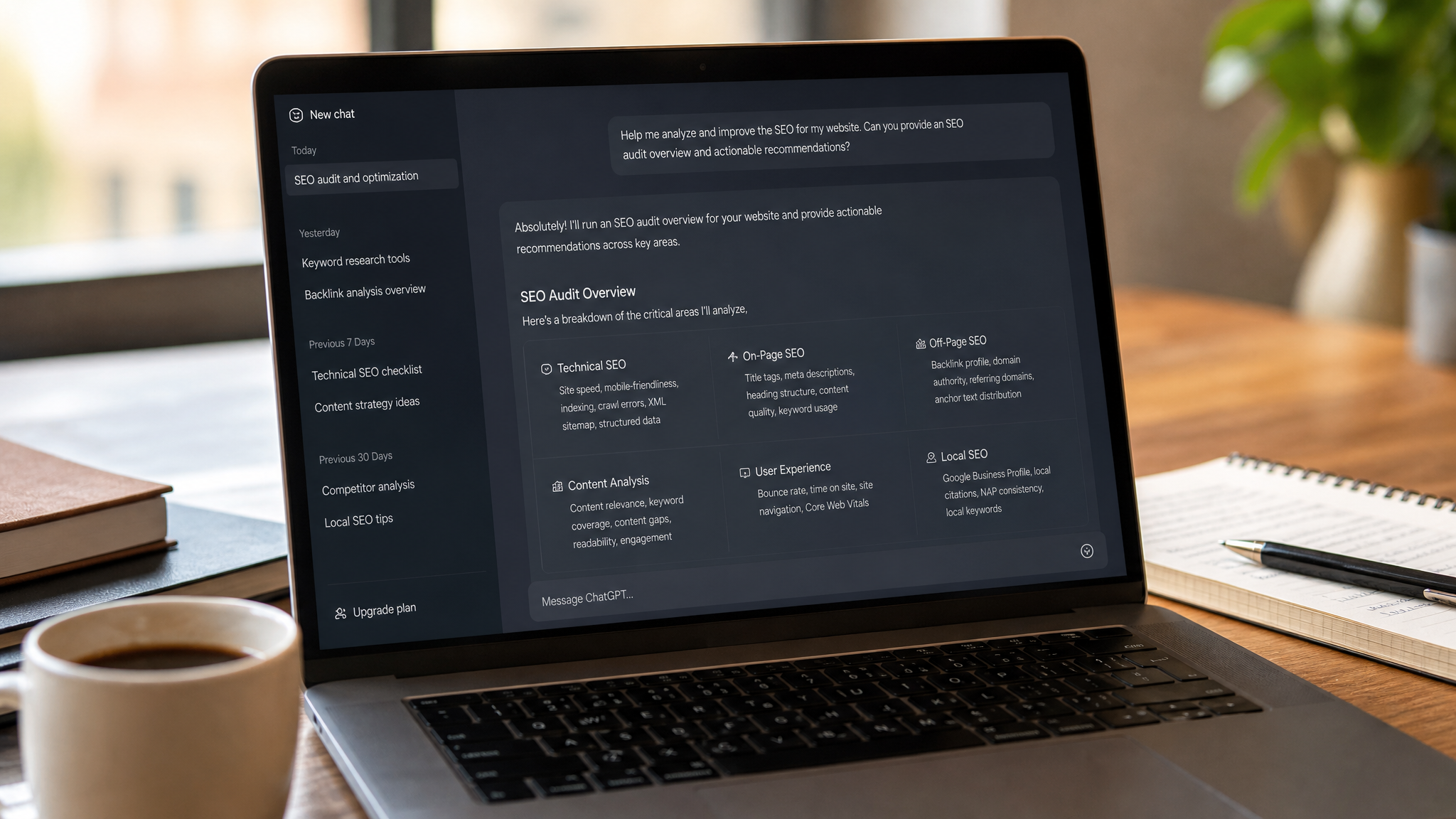
AI SEO tools are software products that use large language models to accelerate the repetitive, language-heavy parts of SEO: research, clustering, outlining, drafting, and optimization. ChatGPT is the most widely adopted because it handles open-ended prompts well and integrates with other platforms through an accessible API.
The realistic value proposition is speed and scale, not magic. A task that takes an analyst two hours — say, expanding a seed term into fifty long-tail variants grouped by intent — can take a skilled prompter ten minutes with ChatGPT.
ChatGPT vs Traditional SEO Workflows
Traditional SEO relies on keyword tools for data, crawlers for technical audits, and writers for content. ChatGPT does not replace any of those. What it does is fill the cognitive gaps between them: synthesizing research into briefs, generating title variants, spotting topical gaps, and drafting at volume.
The distinction matters because teams that expect ChatGPT to replace Ahrefs, Screaming Frog, or Google Analytics will be disappointed. Teams that treat it as a research and writing accelerator layered on top of those tools see measurable output gains.
Where ChatGPT Fits with Google SEO
Chat GPT Google SEO alignment comes down to one question: does the output serve the reader? Google's helpful content guidelines prioritize content written for people, demonstrating first-hand expertise and accurate information. ChatGPT can produce the scaffolding; humans must supply the expertise and verification.
Set realistic expectations. AI-assisted content can rank well when it is accurate, well-structured, and genuinely useful. The ROI is real, but so is the learning curve. Human oversight is not optional — it's what separates a scalable content operation from a spam factory.
Keyword Research with AI SEO Tools
Seed Expansion with GPT
Start with a single seed term and ask ChatGPT to generate long-tail variations, related questions, and semantic entities. A prompt like "Expand 'project management software' into 30 long-tail queries grouped by job role" returns structured output in seconds. Run the same expansion across a dozen seeds and you have the raw material for an entire content calendar.
That raw material still needs validation. Pull search volumes and keyword difficulty scores from a dedicated tool — Semrush, Ahrefs, or Google Search Console — before committing to any cluster. ChatGPT doesn't have live search data; it has language patterns. The combination of both is what produces a defensible keyword strategy.
Search Intent Clustering
Grouping keywords by intent and funnel stage is tedious manually. With a structured prompt, ChatGPT can sort a flat list of 100 keywords into informational, navigational, commercial, and transactional buckets in one pass. From there, map each cluster to a page type: blog post, landing page, comparison page, or product page.
This step is foundational to a gpt chat seo workflow because intent-mismatched content rarely ranks, regardless of how well it's written. Getting the clustering right upstream saves significant rework downstream.
SERP Feature and Competitor Analysis Prompts
Feed ChatGPT a target keyword and ask it to hypothesize which SERP features — People Also Ask, featured snippets, local packs — are likely based on query type. Then verify against an actual SERP. Use those patterns to shape content angles: a query with a dominant featured snippet needs a concise, directly phrased answer in the first 100 words; a query dominated by video suggests multimedia content.
Topical maps and internal link hubs can also be generated this way, giving your team a structural view of content demand before a single brief is written.
Creating SEO Content with ChatGPT
Outlines and Briefs
A strong chat GPT SEO article starts with a strong brief. Use ChatGPT to convert a keyword cluster into a content brief that includes target headings, FAQ candidates, word count guidance, and schema opportunities. A prompt structured around the target intent, competing page summaries, and audience sophistication level produces far more useful output than a vague "write me an article about X."
Drafting and Optimization
Draft sections with intent matching as the primary constraint. If the section targets an informational query, the tone should educate; if it targets a transactional query, it should convert. Ask ChatGPT to incorporate specific entities, synonyms, and internal link anchors rather than generic filler — this improves topical coverage without keyword stuffing.
Formatting matters for featured snippet eligibility. Use seo with chat gpt to test different answer formats — paragraph, numbered list, table — against the SERP feature the target query typically triggers. Tailor CTAs to the funnel stage the reader is in.
E-E-A-T and Fact-Checking
ChatGPT hallucinates. It presents fabricated statistics, misattributed quotes, and outdated information with the same confident tone it uses for accurate content. Every factual claim in a draft must be verified against a primary source before publication.
Beyond accuracy, E-E-A-T requires demonstrating first-hand experience. Add practitioner insights, original data, client results, or named author credentials. These signals are what separate authoritative content from plausible-sounding content — and increasingly, what Google's quality raters look for.
On-Page Optimization and Technical Tips

Titles and Meta Data
Use ChatGPT to generate five to ten title and meta description variants per page, each aligned to a slightly different keyword angle or emotional hook. Then evaluate them against character limits (roughly 60 characters for titles, 155 for meta descriptions) and intent match. Having options accelerates A/B testing and reduces the bottleneck of single-writer title reviews.
Internal Links and Schema
Internal linking at scale is a genuine pain point. ChatGPT can suggest anchor text variants and target URL pairings based on a provided sitemap or content inventory, reinforcing topic clusters without repetitive anchors that trigger over-optimization flags.
JSON-LD schema templates for Article, FAQ, and HowTo markup are also straightforward to draft with ChatGPT. A well-structured prompt specifying the schema type and key fields produces a deployable template that a developer can adapt in minutes rather than hours.
Page Experience and Core Web Vitals
ChatGPT won't fix your Largest Contentful Paint score, but it can synthesize a crawl report or PageSpeed Insights export into a prioritized list of fixes with plain-language explanations. That's genuinely useful for communicating technical recommendations to non-technical stakeholders or bridging the gap between an audit and an implementation ticket.
Workflow Integration and Automation
Prompt Libraries and SOPs
The teams that get consistent results from AI SEO tools build prompt libraries — documented, tested prompts for briefs, outlines, title generation, and fact-check checklists. Standardized SOPs for seo with chat gpt specify which tasks go to the model, which require human judgment, and what quality checks happen before anything publishes.
API and Spreadsheet Automation
The ChatGPT API connects to Google Sheets, Airtable, and custom scripts. Practical automations include bulk meta description generation from a list of page titles, keyword clustering at scale, and automated brief creation triggered by a new keyword addition. These workflows compound over time and free up strategists for higher-value analysis.
QA and Human Review
No draft goes live without a human review. Editors check for accuracy, brand voice consistency, compliance with any regulated-industry requirements, and originality. Logging prompt versions and output quality over time creates a feedback loop that improves results and surfaces which prompt structures consistently underperform.
Risks, Limitations, and Compliance with Google SEO
Content Quality and Originality
Thin content, hallucinated statistics, and near-duplicate pages are the three most common failure modes when teams over-rely on ChatGPT. Mitigate them with strict word-level plagiarism checks, mandatory source citation requirements, and a minimum editorial review time that can't be shortcut for throughput reasons.
AI Disclosure and Policies
Chat GPT Google SEO compliance means staying current with Google's spam policies and helpful content guidance. Google's stated position is that AI-generated content isn't inherently against its guidelines — low-quality, unhelpful content is. Disclose AI assistance where your industry or audience expects transparency, and ensure a named human author takes accountability for every published piece.
Measuring Impact and Iteration
Track rankings, click-through rate, engagement metrics, and conversion rates at the page and cluster level. Tie performance changes to specific workflow iterations so you know whether a new prompt structure, a schema addition, or a deeper editorial review was the variable that moved the needle. AI SEO tools augment expertise — they don't replace the analytical discipline that turns content into compounding organic traffic.