Best AI Article Generators: Top Tools to Write High-Quality Content

Best AI Article Generators: Top Tools to Write High-Quality Content
Content teams are under pressure to produce more — more blog posts, more product guides, more thought-leadership pieces — without proportional increases in budget or headcount. AI article generators have stepped in to close that gap, and the market has matured quickly. Choosing the right tool, though, requires more than picking the one with the flashiest demo.
What Is an AI Article Generator and How It Works
An AI article generator is software that drafts long-form content by drawing on large language models trained on vast text datasets. You feed it a prompt, a keyword, or a full content brief, and it returns a structured draft in seconds. The better platforms let you supply outlines, style guides, and brand tone documentation so the output aligns with your voice — not a generic internet average.
Core Capabilities
Typical outputs include blog posts, product roundups, how-to guides, and comparison articles. Advanced platforms go further, inserting citations, suggesting internal links, and generating meta descriptions alongside the body copy. Many now include web-browsing modules that pull current data, which matters a great deal for fast-moving topics like software reviews or market analysis.
Prompts steer everything. A vague prompt produces vague copy. A prompt that specifies the primary keyword, target reader, desired word count, CTA, and three competing URLs to outrank will produce something far more usable. Most experienced teams treat the brief as the real creative work — the AI handles the drafting.
Limitations and Safeguards
Hallucinations remain the most serious limitation. AI models can confidently state incorrect statistics or attribute quotes to the wrong sources. No ai tool for article writing eliminates this risk entirely; it shifts the responsibility to the editor. Fact-checking, source verification, and a final read for brand consistency are non-negotiable steps before any piece goes live. Think of the AI as a fast first-draft engine, not a publishing pipeline.
Key Features Buyers Should Compare
Not all AI article generators are built the same. Evaluating them on a few specific dimensions will save significant time and money.
Content Quality Controls
Look for factuality tools — some platforms flag low-confidence claims and prompt you to verify. Tone controls and custom style profiles let an ai article writer tool mimic your brand's register rather than producing that unmistakable "written by a robot" cadence. The ability to train the tool on past content samples is especially valuable for established brands.
SEO and Publishing
Strong SEO functionality separates professional-grade tools from basic text generators. Keyword clustering, outline generation, on-page scoring, meta tag creation, and internal link suggestions should all be on your checklist. Platforms that integrate directly with Google Search Console or pull live SERP data can help writers understand search intent before drafting, not after.
Workflow and Collaboration
Research aids matter too. Citation support, web browsing, brief templates, and brand voice training are features worth prioritizing when selecting an ai tool to generate content at scale. For teams, collaboration features — shared workspaces, commenting, role-based permissions — reduce the email back-and-forth that kills productivity.
Compliance and Ownership
Read the fine print on data privacy and content ownership before signing anything. Some vendors reserve the right to use your inputs for model training. Verify that the platform runs plagiarism checks or provides originality scores, and confirm that you hold full commercial rights to the output. For clients in regulated industries, these terms are critical, not optional.
Top AI Article Generator Tools Compared
Best for Solo Creators
Solo bloggers and freelancers need speed, affordability, and templates that cover common formats — listicles, reviews, tutorials. Tools like Jasper and Writesonic serve this tier well, offering template libraries, one-click outline generators, and reasonable monthly caps. Editor experience matters here: a clean, distraction-free interface with inline suggestions beats a cluttered dashboard when you're working alone.
Best for Agencies
Agencies need volume, consistency, and client management features. Surfer SEO's content editor pairs naturally with AI drafting tools, giving account managers an auditable SEO score for every deliverable. Content at Scale and Koala Writer are frequently cited for producing longer drafts that require less editing — a real advantage when your team is producing 50-plus articles a month. CMS integrations with WordPress and Webflow, along with Google Docs compatibility, are table-stakes at this tier.
Best for Enterprises
Enterprise buyers need security controls, SSO, dedicated support, and API access. OpenAI's API, Anthropic's Claude, and platforms built on them (like Writer.com) are common choices at this scale. These tools allow deep customization — feeding the model your style guide, terminology glossary, and approved claim library. Review integrations with analytics platforms and Search Console to close the loop between content output and ranking performance.
Pricing Models and ROI
Credit-Based vs. Unlimited
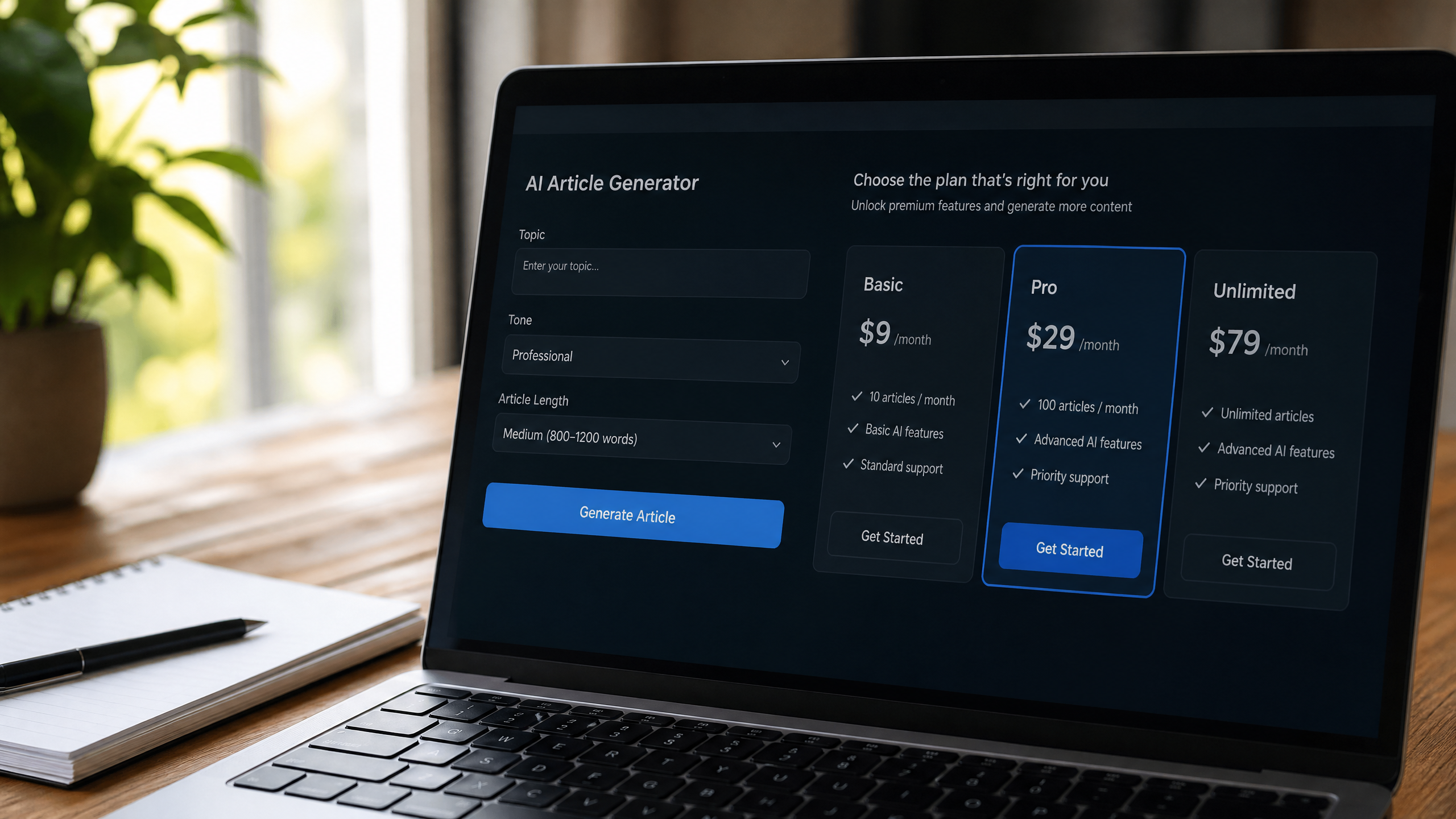
Most ai tools to write articles fall into two pricing structures: credit-based plans, where you pay per word or per generation, and unlimited tiers with fair-use throttling. Credit models work well for low-volume or variable-volume teams. Unlimited plans favor high-volume operations but often come with daily generation limits or queue delays during peak hours — check the throttling policy before committing.
Cost Per Article Math
Run the numbers before you buy. Estimate your monthly article volume, average word count, and expected revision cycles. A team publishing 20 articles per month at 1,500 words each, with two revision passes per piece, will consume very different resources than a team publishing five 800-word posts. Factor in add-ons — SERP analysis modules, plagiarism checkers, and additional team seats can add 20–40% to the base price.
The ROI case usually rests on three levers: faster drafts (cutting production time from 4 hours to 90 minutes per article), reduced outsourcing spend, and improved organic traffic from better SEO coverage. If one additional ranking article generates $500 in monthly organic traffic value, the math on a $99/month tool closes quickly.
How to Use an AI Tool for Article Writing Effectively
Prompt Templates
The quality of your output is directly proportional to the quality of your brief. A structured template should include the primary keyword, secondary keywords, target reader persona, desired word count, preferred tone, key points to cover, sources to reference, and the CTA. Store these templates in a shared doc so every writer on the team starts from the same baseline.
SEO Optimization Workflow
Work section by section rather than asking for a full 2,000-word article in one shot. Generate the introduction, review it, then move to each H2 in sequence. This gives you tighter control over argument flow and keyword placement. Use related terms — ai tool for writing articles, ai tool to generate content — naturally in subheadings and body paragraphs where they fit the context.
Human Editing Checklist
Before publishing, run every AI-generated draft through a consistent editing process: verify all statistics and citations, add real examples and named case studies, insert internal links to relevant existing content, adjust any sections that sound generic, and confirm the conclusion includes a clear CTA. This final pass is what separates content that ranks from content that clutters.
Evaluation Checklist and Next Steps
Proof of Concept Plan
Don't commit to an annual plan based on a 15-minute demo. Run a two-week pilot where you produce 5–10 articles using two shortlisted tools simultaneously. Track edit time per article, SEO scores at publication, and ranking movement at the 30- and 60-day marks. That data tells you more than any feature comparison chart.
Data Security Questions
Ask vendors directly: Does the platform train its models on customer inputs? How long is data retained after account termination? How is personally identifiable information handled? Document the answers. When you're ready to roll out, build an onboarding plan that covers style guide setup, prompt training for writers, and measurement benchmarks tied to organic traffic and content quality scores.
The right ai article writer tool won't replace your editorial judgment — it will accelerate the work that judgment governs. Choose deliberately, pilot rigorously, and edit every draft before it reaches your audience.